
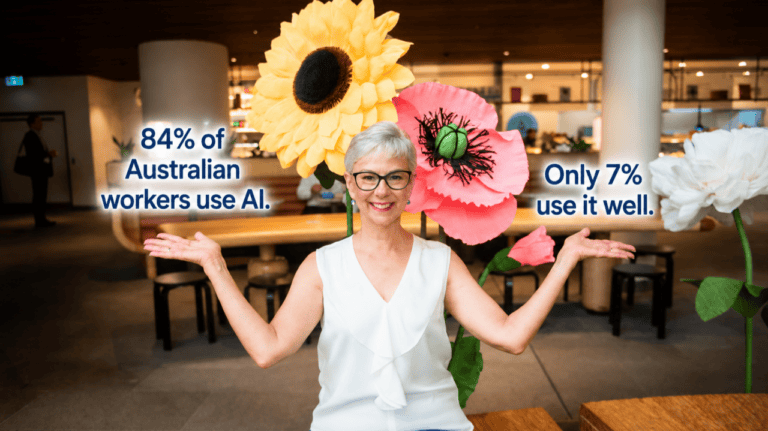
84% of Australian workers use AI. 7% use it well. Nobody in your leadership team knows which number describes their team.
That’s not a rhetorical flourish. It’s the finding of new research from RMIT Online and Deloitte Access Economics — Beyond Prompting: Measuring the Generational AI Gap, a survey of over 2,000 Australian workers published in April. 84% are using at least one AI tool at work. Only 7% have what researchers classify as advanced AI literacy. 54% are still at beginner level.
Deloitte’s modelling puts a number on what that gap is actually costing the country: closing it — moving beginners to intermediate — would add an estimated $18.9 billion to the Australian economy.
Adoption is nearly universal. Competence isn’t. And almost no organisation is currently measuring the difference.
Here’s where it gets more interesting. A separate study — Microsoft’s 2026 Work Trend Index, Australian cut, 2,000 respondents — found that 63% of Australian AI users are now producing work they couldn’t have produced a year ago. Read on its own, that sounds like the competence question is already answered: people have levelled up. Meanwhile, only 28% believe leadership is clearly and consistently aligned on AI strategy, and 68% say they’re afraid of falling behind if they don’t keep adapting.
Put those two studies side by side and the story changes completely.
Adoption and competence are not the same.
And most organisations are measuring the wrong one. “63% are producing better work” sounds like a capability gain. But RMIT’s research breaks AI literacy into six components:
- Knowledge of the systems,
- Practical skill,
- Ability to transfer skill across tools,
- Critical evaluation of outputs,
- Ethical and legal awareness, and
- Strategic judgment.
Here’s what it finds: across every generation, workers are twice as likely to be advanced in technical skill as they are in judgment. People are getting faster. Very few are getting more discerning.
Overconfidence compounds it. In the RMIT data, 21% of Gen Z workers overrate their own AI ability, compared with 8% of Boomers. The workers producing “work they couldn’t produce a year ago” may well be producing it faster, with more polish, and with less scrutiny of whether it’s actually right.
This is the part leadership can’t see from the outside. When someone hands you a sharper-looking deck or a faster turnaround, you have no way of knowing whether that’s genuine capability uplift or a beginner running a more confident-looking beginner’s process. The visible signal — speed, polish, apparent fluency — has completely decoupled from the thing that actually matters: judgement about when to trust the output and when to override it.
And here’s where the two studies reinforce each other in a way that should worry you more, not less. Only 48% of Australian workers report getting any formal AI training from their employer. And I can tell you from running my own series of AI trainings for numerous cohorts, the training that they are getting is primarily technical.
One of the participants that was in a session today said something to the effect, “This context is so important. I’ve been trained how to use the tools but now why I’d use which capability and how to verify the outputs.”
Most people are teaching themselves, through trial and error, with no one checking whether what they’ve taught themselves is any good. Combine that with the leadership alignment gap Microsoft found — just 28% believe their leaders have a coherent AI strategy — and you get an organisation where everyone is moving, nobody is being assessed, and leadership has no visibility into which is happening under its own roof.
That’s not an AI skills problem. It’s a measurement problem, and it’s a leadership problem before it’s a technology one.
What this actually requires from leaders
This is exactly why I build my Everyday AI sessions around comprehension over compliance. A policy that says “use these approved tools” does nothing to address whether people know how and why they should use which tools for which tasks – not to mention how they evaluate the output.
Three shifts matter more than any training rollout:
Stop treating fluency as evidence of competence. Someone moving fast and sounding confident with AI is not the same as someone who knows when and how to question and verify its output. Ask different questions in performance conversations — not “are you using AI?” but “tell me about a time you caught it being wrong.”
Build in structured challenge, not just structured training. The self-taught, trial-and-error learning RMIT documented isn’t inherently bad — but without any check on judgement, it entrenches confident errors as fast as it builds real skill. A single workshop won’t fix this. Regular, low-stakes moments where people have to defend an AI-assisted decision will.
Close the alignment gap before you try to close the skills gap. You cannot ask people to slow down and evaluate more carefully if leadership itself has no visible, consistent position on what “good” AI use looks like in your organisation. The 28% alignment figure isn’t a communications problem. It’s a strategy vacuum, and people fill vacuums with their own untested judgement.
The organisations that will actually benefit from this moment aren’t the ones with the highest adoption numbers. Adoption is now the easy part — 84% clears that bar without anyone trying particularly hard. The organisations that win will be the ones that can tell the difference between their 7% and their 54%, and that build leadership capable of seeing that difference before it shows up in a client-facing mistake.
Your team may not be ahead of you. They may very well be faster than you. Those aren’t the same thing, and confusing them is the actual risk sitting inside most Australian organisations right now.
