
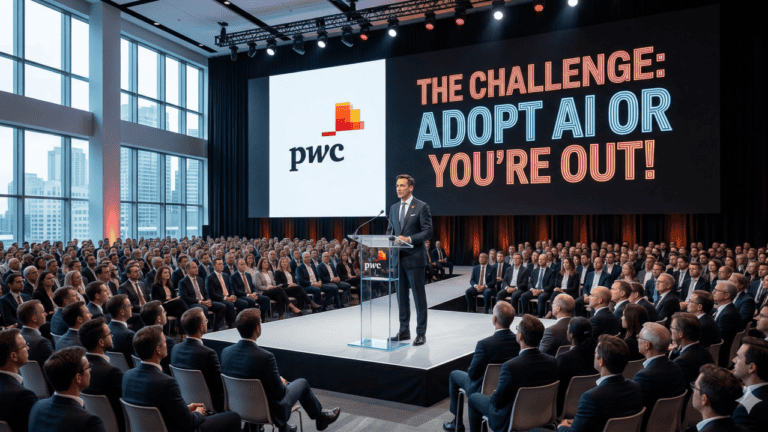
PwC s CEO just told their partners, adopt AI or you’re out.
Awkward timing.
Because PwC’s own research, published just weeks earlier, found that 56% of companies already using AI have seen neither higher revenues nor lower costs.
Not sceptics.
Not laggards.
Organizations actively using AI are getting nothing.
That’s the part most of the commentary missed.
This isn’t a workforce problem; it’s a strategy problem (like so many problems we see in organizations).
Too many organizations are rolling out AI tools without redesigning how work actually gets done. Then they act surprised when the results are underwhelming.
Because:
- Usage isn’t adoption.
- Adoption isn’t capability.
- Capability isn’t value.
Those are four completely different things.
Most organizations are still measuring the first one and congratulating themselves as if they’ve achieved the fourth.
That’s how you end up with AI theatre instead of AI transformation.
Interestingly, in the same conversation, PwC CEO Paul Griggs said something far more useful than the ultimatum: “AI raises the floor. Humans raise the ceiling.”
That’s the real story. The organizations getting value from AI aren’t winning because they’ve forced more people to use the tools.
They’re winning because they’ve done the harder work: redesigning workflows, building judgement, reshaping roles, and helping teams understand where AI helps — and where human thinking still creates the edge.
Mandating adoption under threat may increase activity. But activity is not value.
In fact, when leaders confuse AI activity with AI value, they don’t just waste tools. They waste budget, trust, and decision quality.
I’ve seen what that looks like inside organizations:
- AI-generated outputs nobody fully trusts.
- Faster processes with worse judgement.
- Teams performing adoption for leadership while quietly disengaging from the work.
The companies that win with AI this decade won’t be the ones with the highest usage rates. They’ll be the ones with the strongest human capability around it.
Because usage is easy to mandate, whereas value isn’t.
So what are you really seeing in your organisation: genuine capability, or performative compliance?
Hi, I’m Kim — I’m an award-winning Business Futurist who helps organizations and humans stay relevant, resilient and ready for anything.
Keynote speaker. Advisor. Trainer.
Professional dot-connector and future-nerd.Planning a conference or leadership offsite this year? If future trends for AI are even remotely on the agenda, let’s chat!
