
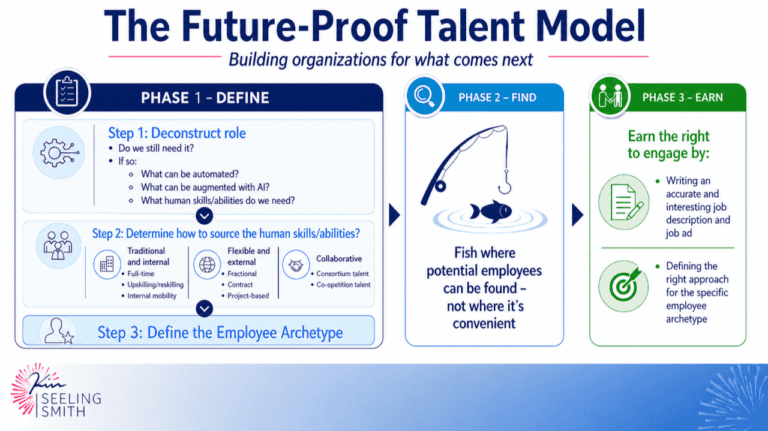
Over the last few weeks, I’ve been refining the Future-Proof Talent Model.
Not changing the thinking behind it — just honing it. Making it sharper, cleaner and more useful.
I’ve also used ChatGPT’s new image generator to create a new graphic for the model, and I like it much better than the original.
That’s separate, but still important.
Because if a model is worth using, it should be easy to understand, explain and remember.
And this part of the model matters a lot — because this is where many organizations still get it wrong.
They know they need someone. They may even have thought more carefully about the work itself. But when it comes time to define the person, they slip straight back into old habits.
They pull out the old position description, build a checklist, add years of experience, recycle the same assumptions, and then wonder why they get a sea of sameness.
That’s not strategy — that’s pattern-matching.
If we’re serious about building organizations for what comes next, we need to get much better at defining the human being we’re actually looking for.
Not just the role or the skills — the person.
Why I say employee archetype
I’m using the phrase employee archetype very deliberately.
Not candidate archetype — employee archetype.
Because words matter.
To me, candidate is still a bit vague and abstract. It describes somebody who could work for you.
But employee lands differently. It makes you picture somebody actually in the role — doing the work, working with the team, navigating change and delivering outcomes.
It’s subtle, but I think it matters.
Because the goal isn’t to attract some abstract candidate.
The goal is to identify and engage the kind of person who can actually succeed in your organization.
That shift in language changes the way we think — and when we think better, we usually hire better.
So what is an employee archetype?
An employee archetype is a deeper definition of the kind of person most likely to succeed in a role, a team or an organization.
Not based on surface traits, a made-up persona or fluff.
It’s about patterns — what motivates them, how they behave, how they respond to change, how they learn, what gives them energy and what kind of environment helps them thrive.
That’s a much more useful lens.
Because most organizations are not hiring into steady, predictable environments any more.
The work is changing. The tools are changing. The context is changing.
So if your definition of the right person is still built around a recycled task list and a technical skills checklist, there’s a good chance you’re hiring for the past.
The two things I think matter most
For me, there are two non-negotiables in roles shaped by change:
- low resistance to change
- innate curiosity and willingness to learn
Call it growth mindset if you want. I’m less interested in the label than I am in the reality.
Because when the environment shifts, the people who do best are not always the ones with the neatest CV or the most perfect experience match.
Often, they’re the ones who can learn quickly, adapt well, stay open and keep moving.
Skills can be taught. Systems can be learned. Tools will change anyway.
But curiosity, adaptability and openness to learning are much harder to build from scratch.
And too many organizations still treat those things as nice-to-haves.
They’re not.
Why this matters in the Future-Proof Talent Model
This is a core part of the Future-Proof Talent Model.
Once you’ve thought clearly about the work and decided on the right talent structure, the next step is defining the kind of human who can actually succeed in that environment.
That means moving beyond credentials, generic competencies and clones of the last person in the role.
I’m talking about fit for change, fit for complexity and fit for growth.
Because the best employee is not always the person who looks perfect on paper.
Sometimes it’s the person with the strongest learning orientation.
Sometimes it’s the person with the most adaptable mindset.
Sometimes it’s the person whose motivations actually match the challenge ahead.
That’s what archetype thinking helps you see.
If you get this wrong, the rest gets harder
This is not a small detail — it’s foundational.
If you define the wrong person, everything downstream gets harder.
- The sourcing gets harder
- The messaging gets weaker
- The shortlist gets noisier
- The interviews get murkier
- The decision gets riskier
And in a market shaped by AI, disruption and workforce change, organizations cannot afford to be vague about the kind of human they need.
They need clarity.
Because the organizations that build the strongest capability over the next few years won’t be the ones with the fanciest EVP or the biggest recruiter budget.
They’ll be the ones that think more clearly about the kind of employee who can thrive in what comes next.
And that starts here — with the archetype.
If your organization is grappling with hiring, capability gaps, or workforce design, I work with leaders to rethink talent strategy for a very different world of work. Get in touch if that conversation is timely.
