
The best candidate for your open role may not be on SEEK.
They’re probably not updating their LinkedIn profile because they’re not actively looking for a role.
They’re certainly not waiting for your recruiter to call because they’ve already had ten that day.
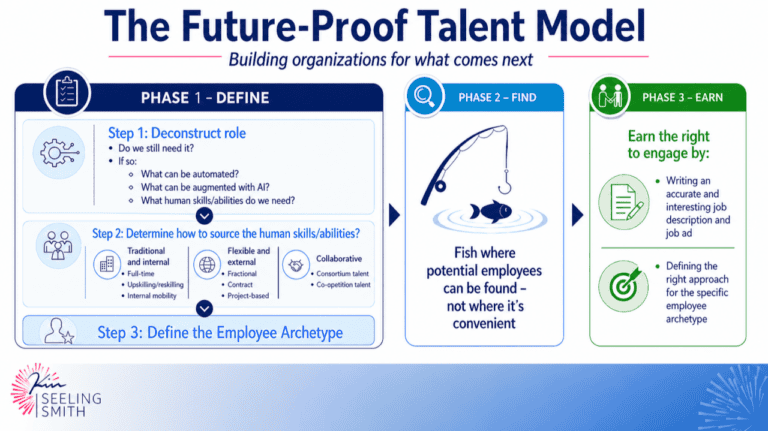
While recently helping a client develop an alternative talent acquisition process for some very hard-to-fill roles, we realised the employee archetype they were looking for is actually spending their time writing conference papers, serving on industry committees, and quietly producing exceptional work for someone else.
We’d done strength profiles on their top performers and knew exactly what archetype we were looking for. Smart, technically deep, intellectually driven. The kind of person whose ideas shape their field.
The instinct — like always — was to write a great ad. And I’ll be honest, after 15 years as a recruiter and nearly two decades advising on hiring strategy, I know how to write a great ad. And that’s what I’ll be covering in next week’s post.
But for this archetype, a great ad wasn’t going to cut it.
Because these people aren’t on SEEK. Many of them don’t even have a current LinkedIn profile because they’ve never needed one. They get approached constantly — by people who know them, because their work speaks for itself.
Here’s the thing most hiring managers miss: changing jobs is not the same kind of decision for the candidate as it is for you.
For an employer, it’s a commercial decision. Doesn’t work out? You move on.
For the candidate? It’s a deeply personal one. Changing roles means, in part, changing how they see themselves. In Western culture, identity is bound up in what we do and where we do it. It can affect time with family, relationship dynamics, where they live. The stakes are completely different.
So when you approach top talent with “Hey, we’ve got a role — come check us out,” you’re essentially walking up to a stranger and proposing marriage.
No courtship. No relationship. Just: jump in.
It doesn’t work. And frankly, it shouldn’t.
The alternative is to treat recruitment like business development.
You don’t cold-pitch your best prospects on day one. You get to know them. You let them get to know you. You build a relationship so that when the needs of your organization intersect with the needs of their career, it feels like the obvious next step — not a risk.
For my client, that meant going to the conferences where their archetype presents. Reading the papers they write. Getting onto the committees they serve on. And critically — having that outreach come from peers, not recruiters. These people get approached by talent acquisition teams constantly. They don’t respond. But they do respond to someone doing the same kind of work at a comparable level.
That last point has real implications. My client happens to be a professional services firm — which means the peers best placed to build these relationships are fee earners. Asking them to give up time for talent-building isn’t just uncomfortable. It flies in the face of standard operating procedures for their entire industry. Utilisation is sacrosanct. Billable hours are the currency everything is measured against.
And yet.
Recruitment has to become everyone’s job.
We’ve been filling roles like takeaway orders for decades. Go to the market, buy the widget-maker we need, as and when we need them. The talent market has fundamentally changed. That model no longer works for the roles that matter most.
As Einstein said:
You can’t solve a problem at the same level of thinking that created it.
Fish where the fish are. Not where it’s convenient for you.
Know your archetype. Know where they spend their time, what they care about, and who they respect. Then show up there — consistently, authentically, and without a job ad in your hand.
That’s the Modern Talent Model in practice.
What’s the most effective — and unconventional — way you’ve seen an organization attract exceptional talent? I’d love to hear it.
Interested in having your recruitment process reviewed and revitalised? Let’s chat. One recruitment review I did saved the company hundreds of thousands of dollars per year – and led to them hiring MUCH better candidates.
