
Tell me if this sounds familiar…
Someone leaves. A manager panics. HR gets a brief. A job ad goes live.
Or…we decide to add headcount and we take an old job description and simply tweak it for the new role without thinking through what’s truly needed.
And then everyone acts surprised when the process is slow, expensive, and underwhelming.
The problem is that many organizations are still treating talent acquisition as an exercise in replacing headcount, when what they actually need is a more strategic way of thinking about capability.
This is not just about hiring faster.
It is about making smarter decisions around capability, capacity, and the organizational design your business actually needs now.
Because the real question is not, “How do we fill this role?”
It is, “What is the smartest way to get this work done?”
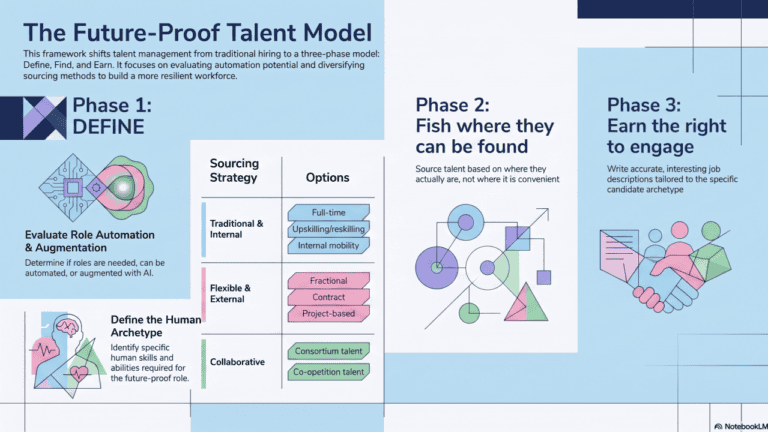
That is where the Future-Proof Talent Model comes in.
Because “just replace the person who left” is lazy strategy.
It is old school thinking.
The Future-Proof Talent Model starts with a decision matrix.
Before you recruit for a new role, ask:
Do we really need this role at all?
If so:
- What can be automated?
- What can AI do, or help our current team do better?
- What human skills are actually required?
And then:
- Does this really need to be a full-time role?
That last question matters more than many leaders realize.
For decades, organizations have defaulted to full-time employment as the standard answer. But work is no longer that simple. Some roles need a full-time employee. Some need a fractional expert. Some need a contractor for six months. Some need a project team. Some need reskilling from within.
And some, frankly, should never be hired for in the first place because the task itself can now be automated or redesigned.
This is where talent strategy gets interesting.
Because the modern workforce gives us more options than ever:
- Full-time employment when continuity and depth are essential.
- Fractional talent when you need expertise, but not 40 hours a week.
- Contract or gig talent when the work is time-bound or specialized.
- Mobilization when the capability already exists somewhere in the business.
- Upskilling and reskilling when potential matters more than a perfect match.
- Consortium talent when industries or member groups share access to talent pools.
- Co-opetition talent when even competitors recognize that scarce capability requires new models.
That is a very different lens from traditional recruiting.
And it matters because too many companies are still hiring people into bloated, outdated roles. They recruit for 32 hours of genuine value, then pad the rest with miscellaneous tasks and call it a job description.
That is not workforce strategy. That is administrative convenience.
The Future-Proof Talent Model asks leaders to design work more intelligently.
Not: Who can we hire to do this job as it has always been done?
But: How should this work be done now, and what is the best talent model to support it?
That shift changes everything.
It reduces waste. It widens the talent pool. It creates more flexibility. And it gives organizations a better chance of matching real capability to real business need.
In other words, it moves talent acquisition out of process mode and into strategy mode.
And that is the point.
Because the future of work will not be won by companies with the longest shortlist.
It will be won by companies that know how to combine automation, human capability, flexibility, and fit in a much more deliberate way.
Once you have worked through the talent model itself, the next question is obvious:
Who, exactly, are you looking for?
Not by title. Not by years of experience. Not by a tired list of technical requirements.
But by archetype.
Because if you define the wrong person, the rest of the strategy falls apart.
And that’s what I’ll be talking about next week.
If your organization is grappling with hiring, capability gaps, or workforce design, I work with leaders to rethink talent strategy for a very different world of work. Get in touch if that conversation is timely.
