
I’ve just read one of the best productivity reports of 2026. Almost every word of it could have been written in 1996.
Both of those statements are true. And the second one is not the criticism it sounds like — it’s the most important insight in the entire report, hiding in plain sight.
Let me explain.
Credit where it’s due
EnterpriseWorks Advisory recently released their 2026 Workforce Productivity Report (sponsored by monday.com com), drawing on a survey of 400+ ANZ knowledge workers and senior leaders and a review of more than 125 research sources.
It’s genuinely good work. Comprehensive, rigorous, clearly articulated. If you lead people in Australia or New Zealand, read it.
The headline findings will feel uncomfortably familiar:
83% of employees understand how their work connects to strategy — but only 51% say their organisation actually organises work around its most important priorities. A 32-point gap between knowing and doing.
45% of the working week is spent in meetings. Only 44% agree most of those meetings are necessary and move work forward.
49% say constantly changing priorities create rework and wasted effort.
And the finding I’d frame and hang on every boardroom wall: across their entire evidence base, they found no credible studies showing sustained performance gains without improved engagement.
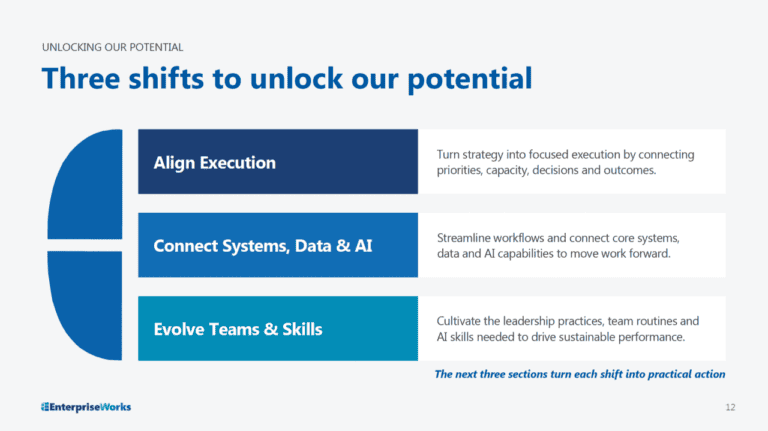
The report sets out three shifts to unlock our potential: align execution, connect systems and data, and evolve teams and skills.
The déjà vu problem
Here’s what struck me as I read it.
Swap “AI” for “digital transformation” and this report could have been published in 2006.
Swap it for “the internet” and it could have been published in 1996.
Strategy that doesn’t survive contact with daily work. Too many priorities competing for the same capacity. Meetings crowding out the actual work. Engagement as the engine of performance. Leaders drowning in reporting instead of leading.
We’ve been measuring employee engagement since the 1990s. The strategy-execution gap has been documented, dissected and consulted on for over three decades. The “too many meetings” complaint is old enough to have a mortgage.
The contributing factors in 2026 are different — 305 systems per organisation, data scattered across islands of information, AI arriving faster than skills can keep up. But the outcomes? The solutions? Fewer priorities. Clearer trade-offs. Protected focus time. Engaged people.
We have known this for 30 years.
Which means knowledge isn’t the problem
There’s a saying most of us grew up with: knowledge is power.
If that were true, we’d have solved this in the nineties.
Three decades of research, thousands of reports, entire consulting industries — and the needle has barely moved. Australia’s labour productivity grew just 0.3% last year while total hours worked rose 2.2%. We are working more and producing barely any extra. Knowledge, on its own, has demonstrably not been power.
So why haven’t we acted?
Because these problems are painful but survivable. Organisations have been able to absorb the cost of misalignment and disengagement and still muddle through.
Because stopping things is harder than starting them. Every executive knows how to launch a priority. Very few are rewarded for killing one.
Because the discomfort of changing how we work has always felt bigger than the cost of leaving it alone.
Until now.
AI didn’t create these problems. It ended our ability to ignore them.
This is where 2026 genuinely differs from 1996, and it’s why this report matters despite — actually, because of — its familiar conclusions.
AI is releasing capacity at a scale we’ve never seen. The report cites Boston Consulting Group (BCG)‘s research showing 60% of leaders already save at least a full workday every week with AI. That’s real, and it’s accelerating.
But here’s the catch: freed capacity poured into a misaligned organisation simply disappears. It gets absorbed by more meetings, more reporting, more rework. The report found 42% of frontline AI users save a full day a week — and most get no guidance on what to do with it.
The 30-year-old problems we never fixed have just become the bottleneck on the newest technology we’ve ever had.
And the maths of inaction has changed. When your competitor was also misaligned, also drowning in meetings, also haemorrhaging engagement, the playing field was level. Now the organisations that fix the old problems get to compound AI’s benefits on top — and the gap between them and everyone else widens at machine speed.
Nothing has changed in 30 years. And now, everything has.
So what will it take to turn knowledge into action?
I’ve spent more than two decades studying why organisations know what to do and don’t do it. Here’s my honest answer.
A forcing function, not another framework. People don’t change when they understand — they change when they experience. It’s why I demo AI live in every keynote rather than talking about it. The moment a room of executives watches a 30-second prompt do what used to take a day, the conversation shifts from fear to strategy. Reports inform. Experiences convert.
Subtraction before addition. Every priority added without one removed is a tax on the ones that matter. The leaders who turn knowledge into action won’t be the ones with the best AI strategy deck — they’ll be the ones with the courage to stop things. Fewer priorities, explicit trade-offs, and the discipline to let work land before launching the next change.
Treating engagement as infrastructure, not sentiment. The report’s most powerful finding — no sustained performance without engagement — was true in 1996, it’s true in 2026, and it will be true in 2036. Engagement isn’t the soft stuff. It’s the operating system everything else runs on, including your AI investment.
That’s my answer. But I’m genuinely curious about yours.
What’s the oldest “known” problem your organisation is still living with — and what do you think it would actually take to finally act on it?