
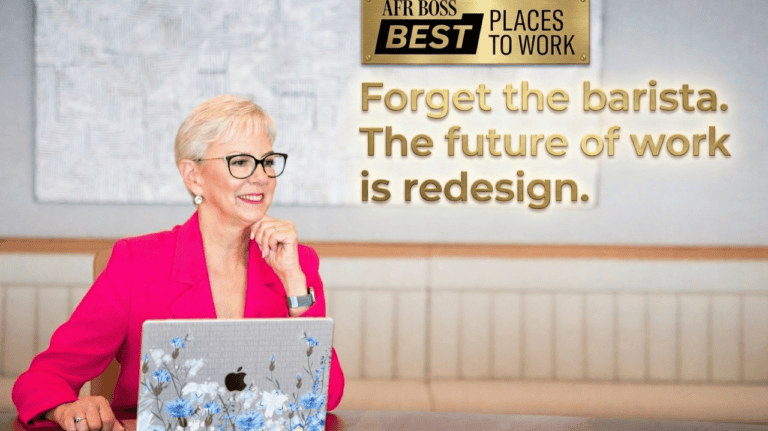
I spent the long Easter weekend diving into the 2026 The Australian Financial Review BOSS Best Places to Work Awards.
What stood out to me wasn’t the list itself. It was the pattern beneath it.
Because when you look closely at what actually earned these organisations recognition, you don’t see incremental improvement on the standard employee experience playbook. You see something much more significant: a growing number of organisations redesigning work itself – something I’ve been arguing for for over a decade.
Forget the barista. Nobody is staying for the coffee.
There is a reason the AFR’s own framing this year moved away from perks. For years, workplace culture was treated like a competition for the best amenity list: rooftop terraces, subsidised lunches, nicer monitors, better snacks. That framing was always wrong.

I know this because I reverse-engineered more than 5,000 exit interviews to develop the 9 Currencies of Choice® — a model that outlines the factors that actually drive engagement, loyalty and performance: purpose, trust, belonging, appreciation, voice, clarity, growth, agency and an ability to play to their strengths. Not one of them is a latte.
What has changed since COVID is not simply that people expect more from work. It is that the conversation has shifted from why people leave to how work is designed. And the best leaders have been forced to confront a harder question: have we actually created the conditions for people to do their best work?
The organisations being recognised now are not just offering nicer benefits. They are redesigning the structural conditions under which people work — giving them more agency, more flexibility, more dignity, and more room to contribute at their actual capability level. 
Equality Media + Marketing, which won both the Media & Marketing category and the national small organisation title in this year’s AFR BOSS awards, runs a four-day full-pay workweek and a leave framework that includes menopause, mental health, pregnancy loss, pawternity and gender affirmation leave. Those are not perks. They are structural redesigns of when, how and under what conditions people are expected to show up. The result was a 17 per cent drop in unscheduled leave and staff retention that nearly doubled. That is not a culture initiative. That is a business result. 
The High Performer Efficiency Tax
One of the most useful ideas to emerge from this year’s coverage is what the AFR called the “high performer efficiency tax”.
You already know what this is, even if you have never heard it named.
It is what happens when your most capable people are identified as reliable — and then quietly loaded up with the work others cannot or will not do. They become the fix-it function. The institutional memory. The clean-up crew. They are rewarded for competence with more volume, less protection and fewer degrees of freedom.
And then they leave.
Or, more dangerously, they stay.
Because this is the part too many leaders still miss: the resignation risk does not disappear when labour markets soften. It just changes shape.
LinkedIn research published in January found that 51 per cent of Australians planned to look for a new role in 2026, down from 59 per cent the year before, while 69 per cent said job hunting had become harder. Gartner’s Australia data, published in February, found only 19.4 per cent of employees were actively seeking new roles in Q4 2025. That is not the same thing as commitment. It may simply mean people feel less confident moving. 
That distinction matters.
When people no longer believe the market will reward movement, dissatisfaction does not vanish. It goes underground. People stay, but checked out. They comply, but they do not contribute at full capacity. They are present, but not invested.
And that is where this year’s best workplaces stand apart.
The organisations topping the AFR list are actively dismantling the systems that punish capability. They are asking better structural questions: are we overloading our best people? Are we confusing resilience with tolerance? Are we still rewarding endurance when the work now demands judgment, creativity and trust? 
This matters even more as organisations push harder on AI.
The AI Argument
If AI is going to automate the dull, dirty and dangerous work, then the value of human work shifts upward — toward strategy, judgment, creativity, complex problem-solving and relationship-building. But if your best people are still buried under admin, operational drag and the fallout from others’ underperformance, you lose twice. You fail to capture the value AI could unlock, and you drive out the very people best placed to create it.
tfm.digital‘s CEO Taylor Fielding captured the alternative clearly: leaders set the top-line objectives, and the team decides how to get there, with guidance where needed. That is not just a leadership style. It is a work design philosophy. It distributes agency instead of hoarding it at the top. 
For those of you familiar with my 9 Currencies of Choice model, you will recognise this as the “Target Rich Objectives”.
This is the shift I keep coming back to: most, while most organisations still manage for presence, the best ones design for contribution.
Managing for presence asks: is everyone here and accounted for? Designing for contribution asks: have we built the conditions in which people can actually do their best work?
That difference is not semantic. It is strategic.
Bendelta’s research for the Best Places to Work program found that meaningful work was the strongest predictor of happiness at work across industries. Not the benefits. Not the team offsite. Not the flexibility policy written on paper. Meaningful work. Every time. The same research also found that strong formal HR policies do not automatically produce a positive employee experience, and that visible leadership was a consistent feature of the highest-ranked organisations. 
That should be a wake-up call for every leadership team still mistaking policy for culture.
Your policy document does not do the work. Your culture does.
The organisations at the top of the list seem to understand that. They treat policies as living operating mechanisms — something leaders explain, apply, revisit and improve — not as static proof that the organisation cares. 
And that tells us something bigger about where we are.

I track what I call the three great disruptions reshaping work: AI, the polycrisis, and the rise of the Empowered Workforce. The third is still the most underestimated, especially by leaders hoping a tighter market will make people more compliant.
It will not.
What this year’s AFR winners show is that the organisations winning the talent game in 2026 are not waiting for the workforce to become easier to manage. They are redesigning work to become more worth doing. They are removing the efficiency tax. They are treating leave as a structural recognition of human lives outside work. They are making leadership visible. They are setting direction clearly and pushing agency closer to the work. 
These practices are not secret. They are not especially glamorous. They do not require a billion-dollar budget. A small independent agency can outperform much larger organisations when trust, agency and meaningful work are designed into the system rather than bolted on as benefits. 
So why are more organisations not doing this?
Because structural redesign requires giving something up.
Control. Familiar metrics. The illusion that visibility equals value. The old belief that harder and longer must still mean better.
The best workplaces in Australia are no longer competing on perks. They are redesigning work itself.
The question for leaders is no longer whether that shift is happening.
It is whether you are still rewarding presence when the future belongs to contribution.
Hi, I’m Kim — I’m an award-winning Business Futurist who helps organisations and humans stay relevant, resilient and ready for anything.
Keynote speaker. Advisor. Trainer. Professional dot-connector and future-nerd.
Planning a conference or leadership offsite this year? If future trends, AI or employee engagement/retention are even remotely on the agenda, let’s chat!