
I spent more than 15 years as a recruitment consultant.
In that time I read hundreds of thousands of CVs. That’s not a figure of speech. Hundreds of thousands.
And I’ll be honest with you: a lot of it was soul-destroying.
Most CVs aren’t written well. They’re hard to read, badly structured, and they bury the good stuff three lines from the bottom. Trawling through stacks of them, day after day, is one of the least glamorous jobs in business.
So when AI screening tools arrived promising to do that work for us, I understood the appeal completely. I have a genuine love-hate relationship with CV screening — and AI seemed to lift the part I hated clean off my plate.
But after watching how these tools are actually being used, I’ve come to a firm view.
AI hasn’t fixed the interview process. It’s quietly breaking it — from both sides at once.
Let me show you what I mean.
—
Side one: the score that follows you for almost a year
Most large organisations now screen CVs with AI before a human ever lays eyes on them. Around 90% of US employers use some form of AI screening, and most of them rely on the same small handful of vendors.
That last detail is where it gets uncomfortable.
In May, Stanford’s Institute for Human-Centered AI published the first large-scale study of these tools in the wild — more than four million job applications run through a single screening platform.
They found something most candidates have no idea is happening.
When one of these systems scores you, that score can be stored and reused for up to 330 days. Almost a full year. And because so many employers use the same vendor, the score doesn’t stay put with the company that gave it to you. It travels.
So if one organisation knocks you back because you didn’t match their keywords, that same score can quietly follow you to the next company running the same system. And the next.
The researchers called it “systemic rejection” — being shut out of multiple employers by what is effectively one algorithm wearing different logos. Some candidates in the study were rejected from every single role they applied for. To be reasonably confident of reaching a human even once, an applicant would need to apply for around 25 separate positions.
Sit with that for a second.
A single weak keyword match — not a weak candidate, a weak match — can follow a real person around the job market for the better part of a year. Invisibly. With no appeal and no explanation.
This is the exact thing I hated about screening, supercharged.
Because there’s one thing the keyword match can never do: read a CV as a complete story.
The career pivot that looks messy on paper but makes perfect sense once you understand the person. The transferable skill hiding under an unfamiliar job title. The gem who doesn’t use the “right” words but is precisely who you need.
Some of my best-ever placements came through exactly because a human eye caught what a keyword filter would have binned. You cannot automate that. And when you try, you don’t just lose efficiency — you lose the people who’d have been your best hires.
—
Side two: the candidate reading from a teleprompter you can’t see
Now flip the table.
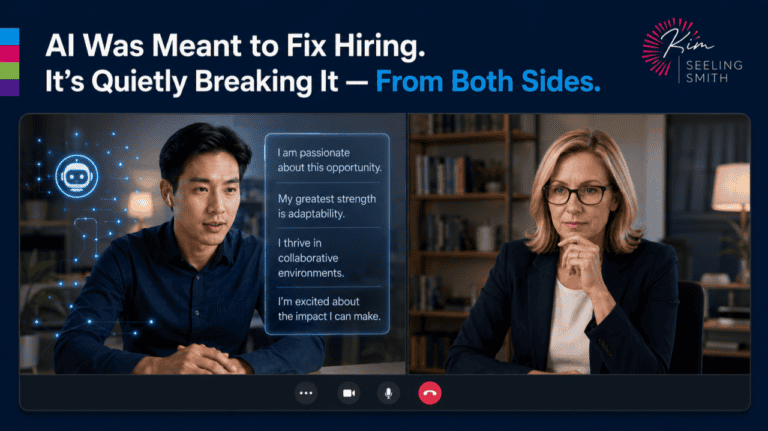
A whole new category of tools — Cluely, Interview Coder, Final Round AI and others — lets a candidate run an invisible AI overlay during a live video interview.
The mechanics are unsettlingly simple. The tool listens to your questions in real time, generates a polished answer, and displays it on the candidate’s screen like a teleprompter. You, the interviewer, see nothing. They appear to be looking right at you, thinking carefully.
They’re reading.
These tools are deliberately engineered to be invisible to screen-sharing software. They cost as little as US$20 a month — a rounding error against a six-figure salary.
I have two problems with this, and only one of them is the obvious one.
The first is obvious: it’s cheating. Full stop.
The second should worry every hiring manager far more. A candidate who can read perfect answers off a hidden screen can land a job they’re not actually qualified for — and, just as importantly, a job they won’t enjoy and won’t stay in.
An interview was never only a test. At its best, it’s a two-way exploration: is this role genuinely a fit for this person’s life, their strengths, the way they want to work? When a candidate outsources their answers to AI, that exploration never happens. Both sides end up talking to a machine.
Candidates have always come better prepared to interviews than most hiring managers and talent acquisition teams. That’s been true my entire career. These tools simply take that asymmetry to its logical, and dangerous, extreme.
My prediction: we’re heading for a wave of expensive mis-hires. Confident, articulate, perfectly-scripted people who interview brilliantly — and then can’t do the job. That cost won’t surface for months. But it will surface.
