
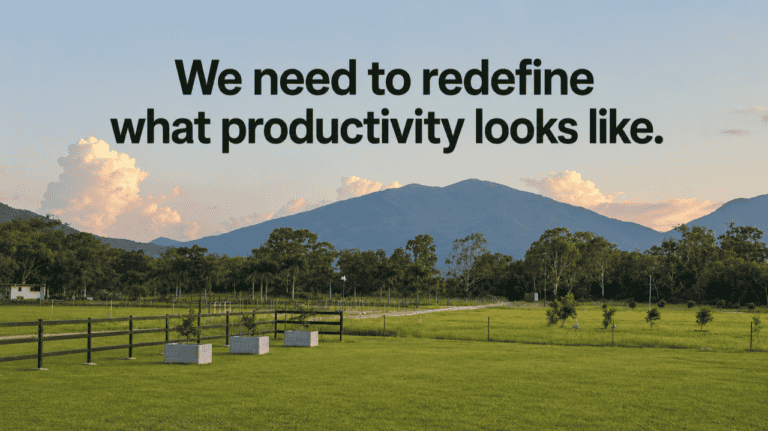
Last Sunday morning I found myself on my back patio, coffee in hand, Mount Elliot in the distance.
And I’m working.
I’ve got a big presentation tomorrow and had carved out 1/2 day to customise it for my client – but it only took about an hour. Because AI.
I found myself with 3 hours of free time – on a Sunday. But instead of taking my dog for a walk, I began to quietly fill that time with more work.
Then I caught myself.
This is the part nobody warns you about when they sell you on AI “freeing up your time for higher-value work.”
The technology isn’t the hard part. We are.
Most human beings are wired to be productive. And we’ve been taught that productive means doing. Output. Tasks ticked off. Visible motion.
So when AI gives us an hour back, we don’t sit with it. We don’t think, strategise, create, or have the messy human conversations that actually move things forward.
We find more stuff to do.
We’ve been here before.
In 1930, John Maynard Keynes predicted that within about a hundred years, technology would have us working roughly 15 hours a week. The great challenge, he thought, would be working out what to do with all our leisure.
He was right about the productivity gains. He was spectacularly wrong about the leisure.
Twenty-five years later, Cyril Northcote Parkinson gave us the law that explains why: work expands to fill the time available for its completion.
Give a task an afternoon, it takes an afternoon. Give yourself a reclaimed hour, and the work rushes in to fill it.
AI is the most powerful efficiency tool we’ve ever been handed. And if we’re not careful, we’ll do exactly what we’ve done with every efficiency tool before it — pour the time we save straight back into doing more of the same.
The opportunity isn’t to do more.
It’s to redefine what “productive” actually means.
For a knowledge worker in 2026, the highest-value work is rarely the doing. It’s the thinking. The strategy. The creativity. The relationships. The judgement no model can replicate.
And that work doesn’t look productive. It looks like staring out at a mountain. It looks like a walk where the idea finally lands. It looks like time a task-counting brain reads as wasted.
It isn’t.
So I closed the laptop.
Not because the work didn’t matter — but because the most future-fit thing I could do with the time AI gave me was something that didn’t resemble work at all.
I took my dog for a very long walk and spent the time thinking (and keeping her from eating Kangaroo poo – what IS the attraction?!?!)
And I came up with a new initiative! Because I spent the time I had scheduled for work thinking instead of doing.
Here’s what I’m sitting with: if AI gave you back five hours next week, do you actually know what you’d do with them? Or would they quietly disappear into your to-do list?
I genuinely want to know — what would you protect that time for?